DDE Server Interface
Appendix
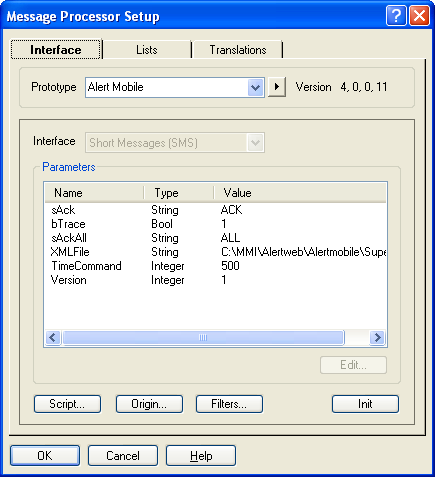
It will be next possible to define variables that will be referenced by the script to parameter its working ( initial parameters ) or to store the value of the fields extracted from the received messages ("filter" variables). The creation and activation of alarms are performed in the script by calling methods of the "Alert" object (defined in the script). These methods use parameters that must be initialized by the script.
A) General presentation The dynamic importation filters allow alarm supervision conditions to be defined in Alert without having prior to define a list of variables to supervise. This feature considerably reduces the work required to configure the software and also authorizes a dynamic self - configuration of the supervision when the supervised system evolves. The configuration of the dynamic importation consists to define a list of importation filters, each filter defining criterions to dynamically create a specific category of alarms. The main task to realize is a preliminary work to specify importation criterions of every alarm to process in order to define the properties of these alarms (ident ifier, messages, group classification, priority, groups to call ...) in function of basic properties attached to data to supervise (type, category, labels, priority, localization ...). The basic properties attached to supervision are variables defined as "fil ter" variables that will be updated by the script before calling the filter processing function (PROCESSEVENT).
The properties of created alarms and possible associated conditions are defined by arithmetic and logical expressions of basic properties of supervised data. To make expressions more clear and optimize the filter evaluation, macro-expressions can be defined. These macro expressions can be used in every filter and are computed only one time just before each processing of the list of filters.
B) Definition of a filter A filter is designated by a unique name.
If the "Filter enabled" checkbox is not checked, the filter will not be processed. The field "Creation condition" defines the condition to create the alarm concerned by the filter. The filter will be evaluated only when this condition is true. Remark: when several filters are defined (list of filters), the filters are processed in the list order and each filter is evaluated regardless of ot her filters. If one wants filter only deals with a specific category of alarms, it is necessary to define an exclusive creation condition, i.e. that condition defines the alarms concerned by the filter with the exception of all other alarms.
Appendix
The field "identifier" designates the created alarm by an identifier. The identifier resulting of the expression written in this field must absolutely be unique. The group "Event definition" defines some properties of the processed event:
- Transitory event: if this check box is checked, the event will be created with the type transitory (no event reset waited). If a condition is defined in the adjacent field, the event will be declared as transitory only if this condition is true.
- Reactivable: if this checkbox is checked, the event will be considered as reactivable (event trigged at every change, any is its previous state). The group "Alarm definition" defines the properties of the event processing as alarm:
- Alarm enabled: if this checkbox is checked, the event will be proc essed as an alarm. If a condition is defined in the adjacent field, the event will be processed as alarm only if this condition is true.
- Priority: this field defines the priority of the alarm. The group " Groups" allows the created event or alarm to be clas sified in a tree of functional groups. A branch of groups is defined by a list of group names (or expressions resulting in a group name) separated by the character "/". The specified groups are automatically created if they not already exist. For each gro up of the list, it is possible to define a membership condition for created alarms. The designated group will be created and the alarm attached to this group only if the condition is true. A special condition (<DEFAULT>) defines a condition that will be tr ue only if none of the previous conditions of the list is true. The tabs " Alarm Processing ", " Reset Processing " and " Acknowledgment Processing " define the actions to perform when an alarm is set (respectively reset or acknowledged) and the information to transmit (long and short message, instruction file). For each alarm, one can define a list of actions as "Call Group", "User Message" or "Script Execution". Each action of the list can depend on a condition. The action will be added to the list only if the condition is true. A special condition (<DEFAULT>) defines a condition that will be true only if none of the previous conditions of the list is true. The designated group (user or script) can be selected among the existing groups (user or script) or explicitly defined by an expression. For the group call, the group will be created only if the option "Group creation" is checked. The call can be disabled (to attach the alarm to a group without having to call it) or conditionally enabled by defining a call condition. A call delay can also be defined.
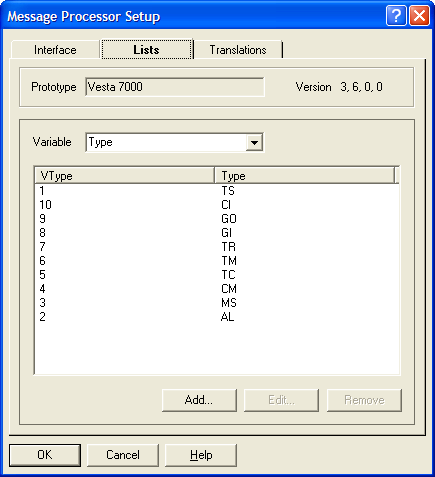
Some variables can be defined as list variables. The list variables allow both the definition of a set of accepted value for a message field and the conversion of a value to another value: f or example, conversion of a message id to explicit message, or association of a machine id to an area number. A list variable is defined in connection with an other variable. Its value depends on the value of the associated variable. The associations betwe en the value of a list variable and the values of its associated variable are defined in the page "Lists" of the configuration dialog box of the message processor.
The value of a list vari able is set by calling the function SETFROMLIST in the script. This function will get from the list the value that corresponds with the actual value of the associated variable. The creation and set/reset of alarms is performed in the script by the mean of methods of the Alert object (defined in the script). These methods use parameters that have to be initialized by the script. This initialization can be automatically performed by calling the function RESOLVEALERTPARAM which will update the parameters of th e Alert interface following the type of translation defined for each parameter and the content of the associated variables:
- translation by value : the parameter is the value of a variable,
- translation by expression : a text including the value of one or se veral variables is recopied in the parameter,
- translation by function : the parameter is a function of a set of 1 to 3 primary parameters. The translations by function are defined in the page "Translations" of the configuration dialog box of the message processor.