Call Options
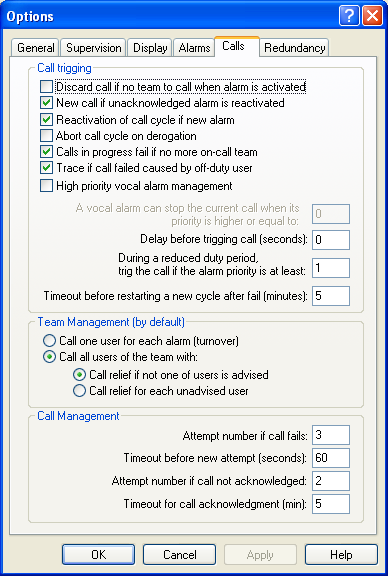
To configur e the call management options, select the Options... command of the Configuration menu, then, on the displayed dialog box, select the Calls tab.
Call trigging This group defines the options attached to the call trigging conditions:
- Discard call if no team to call when alarm is activated . This option defines the behavior of the Alert manager when an alarm is triggered during a period where there is no team to call (no active team in the sched ule or group in derogation state without derogation team). If this option is validated, the alarm is recorded in the alarm table, but the call is discarded. To the next valid on -call time period (or when exiting derogation state), there will be no call for alarms already registered, that they are acknowledged or no. If this option is not validated, the alarm is recorded in the alarm table with the corresponding call request. To the next valid on -call time period (or when exiting
derogation state), the cal l will be automatically triggered, except if the alarm in question were acknowledged meanwhile.
- New call if unacknowledged alarm is reactivated . This option allows a new call to be retriggered when an unacknowledged alarm is reactivated. If this option is not selected, an unacknowledged alarm will not provoke a new call if it is reactivated after a return to the normal state. This option is checked by default.
- Reactivation of call cycle if new alarm . When this option is checked, the apparition of a new alar m reinitialize the call cycle of the concerned group. This option ensures that all new alarm will be signaled to operators even if they have been already called. This option is checked by default.
- Abort call cycle on derogation. When this option is checked, the derogation command for a group immediately aborts the current call cycle of the group. By default, this option is not checked.
- Calls in progress fail if no more on -call team. When this option is checked (default option), the end of the on -call period (no more team in schedule) stops the current call cycle, with fail of the group call if the successful call conditions are not fulfilled.
- Trace if call failed caused by off-duty user. This option validates or not the trace in the event log of the call fai ls that are consecutive to the call of an off -duty operator. When the on -call management is controlled from the supervised application by the modification of the on-duty status of operators, it is preferable to uncheck this option to avoid useless information in the event log.
- High priority vocal alarm management . When this option is checked, all alarms having a priority level higher or equal to the level defined below will provoke priority calls. When a priority alarm requires a vocal call and no vocal lin e is available (vocal calls in progress), one of these vocal calls is aborted (after sending a warning message) to allow the priority call to be performed. The aborted call will be resumed as soon as possible (available vocal line).
- A vocal alarm can stop the current call when its priority is higher or equal to ... This value defines the minimal priority level of alarms requiring priority calls (suspension of calls in progress). This option is only available (not grayed) when the option of management of priority alarms is validated (see above).
- Delay before trigging call . This parameter defines the waited timeout (in seconds) before trigging a call when an alarm is detected. This timeout allows the alarm to be immediately treated by a local operator before starting of the call cycle. By default, this time is 0 (no delay to trigger the call).
- During a reduced duty period, trig the call if the alarm priority is at least . This value defines the minimum level of alarm priority to start a call during a "reduced duty " period. When an alarm has a priority level lower than this value, its activation during a "reduced duty" period for the concerned group will not induce an immediate call. This call will be delayed until the end of the reduced duty period, except if the a larm has been acknowledged meanwhile.
- Timeout before restarting a new cycle after fail . This parameter defines the waited timeout (in minutes) at the end of a call cycle when this cycle did not succeed (including the call of relief operators) to restart th e cycle. If meanwhile the on -call team changed, the call will be performed to the new team. By default, this time is 5 minutes. If this time is null, there is not resumption of the cycle in case of failure (except at the end of the acknowledgment timeout if it is not null).
Team Management This group defines the default options for the management of the teams:
- Selection of the team management mode: Call one user for each alarm, different for every alarm (operator turnover) Call all active users of the team (call broadcasting), with management of relief operators according to options below.
- Definition of the call conditions for relief operators (only for call broadcasting): Call relief if not one of user is advised : a relief operator is called when none of t he main operators of the team has been successfully reached (assures that at less one operator is warned). Call relief for each unadvised user : a relief operator is called every time a team's operator cannot be reached (assures that a constant number of op erators are warned). Call Management This group defines the default treatment options for call failures:
- Attempt number if call fails : maximum number of call attempts to the number when the call failed (no answer, busy ...). This number can be between 1 and 9. The time waited to try a new call depends on the type of failure. In case of no answer or busy failure, this time is that indicated by the parameter below ("timeout before new attempt"). It is reduced to 1 second if the modem does not detect the dial tone.
- Timeout before new attempt: time delay waited after a call failure (no answer or busy) to try a new attempt, in seconds. By default, this time is 60 seconds.
- Attempt number if call not acknowledged : m aximum number of calls of a number when the call s ucceeded but the operator did not acknowledge the call within the defined delay. This number can be between 1 and 9. The call can be acknowledged locally or remote by telephone, by SMS or from a client station.
- Timeout for call acknowledgment : time delay w aited for call acknowledgment when the called operator has been reached, but without certainty (SMS, beeper, pager). This delay can be between 0 and 99 minutes, the value 0 canceling any delay (the call then always is considered as acknowledged).