ALERT - Configuration Process
Overview
The primary function of ALERT is to contact operators as soon as an alarm is triggered. Following a structured configuration approach streamlines the setup process.
Operating Principle vs. Configuration Process
The operating principle flows from alarm to operator notification. The configuration process reverses this direction, moving from operators backward to alarms.
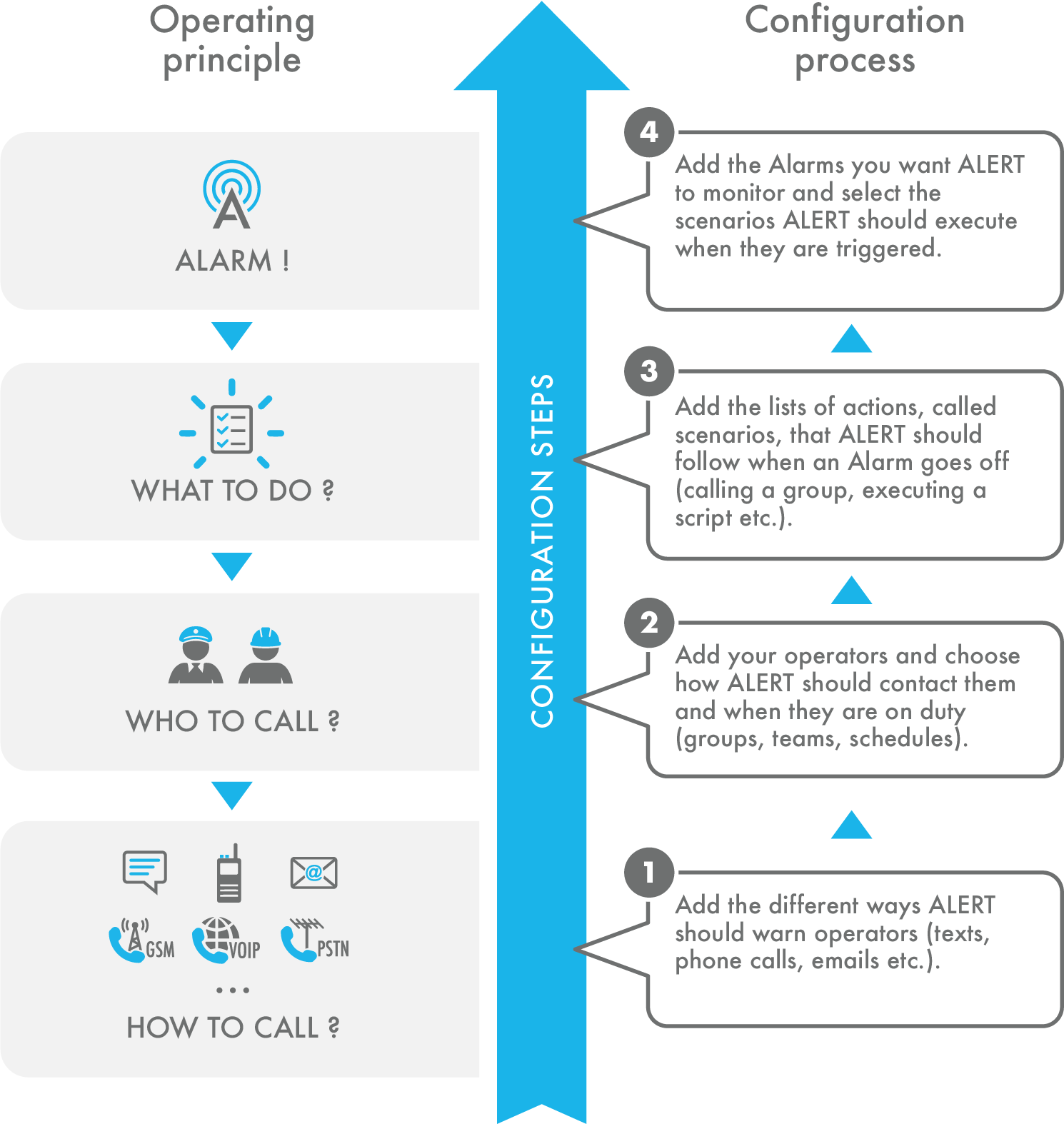
Key advantages of this method:
- Determine desired operating modes before programming ALERT
- Simplify setup through sequential, dependent steps
Communication Channels
To notify on-duty operators and transmit alarm data, you must define and configure the software and hardware that ALERT will use.
For most applications involving voice calls, SMS, or fax transmission, a modem connection is necessary. Modems may be:
- External devices (serial or USB connected)
- Internal cards (PCI or PCI-express)
Configuration covers:
- GSM vocal modems — for voice calls and SMS
- SIP connections — for VoIP capabilities